




Darwin's forgotten essay on sundews
An introduction by John van Wyhe
There is a somewhat mysterious volume in the Darwin Archive at Cambridge University Library (CUL-DAR61) which contains about 140 sheets of mostly blue paper on Drosera or sundews. They are particularly hard to decipher and full of deleted words and later insertions. Although these sheets discuss insectivorous plants, the writing does not match any part of Darwin's 1875 book Insectivorous plants. This is not the draft of the published work.
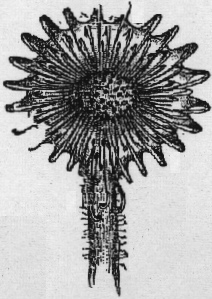
In fact, this volume of Darwin's papers contains an undated and unpublished 25,000 word essay. It is now transcribed and published for the first time. See CUL-DAR61
Darwin began studying insectivorous plants, especially the common sundew (Drosera rotundifolia), in the summer of 1860. Over the course of many years he experimented extensively with plants, testing whether various chemical substances would trigger them to curl up, as they did when an insect was caught on their sticky tentacles. He eventually found that the plant's secretions became more acidic after they had been stimulated by contact with material containing nitrogen, like the body of an insect. And, in typical Darwin style (as with his theory of evolution) he continued to return to the subject between other projects.
In a March 1869 letter to W. C. Tait, Darwin noted: "My MS on this subject has been nearly ready for publication during some years, but when I shall have strength and time to publish I know not." The editors of the Correspondence pointed to this manuscript in CUL-DAR61. The document Darwin referred to in 1869 as done years before could indeed be this one, or part of it. However, the majority of evidence suggests the present essay was written in 1872-1873.
For most of his life, Darwin recorded the progress of his work in his 'Journal' (CUL-DAR158). In 1872 he recorded:
"Aug 23rd Began working at Drosera."
And later that year:
"Nov. 3rd Began writing on do." p. 50v.
This writing was recorded as finished in 1873:
"Jan 15 Finished Drosera"
It is mentioned two more times in 1873:
"June 14th Began Drosera again."
"Oct. 20 Began correcting Drosera M.S."
Two sheets in the Drosera essay are written on the backs of documents that probably date to 1872: CUL-DAR61.88v is an unrecognised part of the draft of Expression (1872) and CUL-DAR61.73 is from the draft of Coral reefs 2d ed. (1874).
The actual draft of Darwin's Insectivorous plants was recorded in his 'Journal' as begun in 1874:
"April 1. Began Insectivorous plants—(interruptions from proof sheets) & went on whole rest of year, writing & some observations." p. 52v.
As he wrote to his cousin W. D. Fox on 11 May [1874]:
"I am preparing a book almost wholly on Drosera or the Sun-Dew, which is a wonderful plant under a physiological point of view, & I think I have made some curious discoveries. One of the chief new points is that it secretes a fluid analogous to gastric juice, for it contains a ferment, closely analogous to pepsine, with an acid, & can thus in a few hours dissolve the hardest cartilage, bone & meat &c. &c." (Correspondence vol. 22)
This 1874 work is the first document on Drosera to be referred to as a book. The completion of the book draft was recorded in 1875:
"March 29th finished M.S. of Insectivorous".
Thus we have Darwin recording the start and finish of two different works- one called "Drosera" and the other "Insectivorous plants", although the latter is mostly about Drosera of course (see Chapters I through XI).
This fifteen-year gestation for a book was typical of Darwin- seen in book after book he published. And, as with Origin of species, Insectivorous plants also went through an intermediate draft stage that was never published. It has not previously been recognised that this work also evolved in the same manner. The mid-twentieth century obsession with Darwin supposedly withholding the Origin of species because so many years elapsed from conception to publication (1839-1858/9) is in stark opposition to his manner of work.
So the draft essay in CUL-DAR61 is not the draft of Insectivorous plants. Indeed that draft was not preserved per se and does not exist in the Darwin Archive. After being sent to make a fair copy, the rough draft ended up in the Darwin family scrap paper pile- just like the draft of Origin of species.
Many sheets of the draft of Insectivorous plants survive as the versos or back sides were later used for other purposes. After Darwin's death some of these re-used draft sheets of Insectivorous plants were given away by Darwin's children as mementos and otherwise preserved as important. These can be found in the Manuscripts section in Darwin Online. See the list here.
The CUL-DAR61 draft essay even has a title page:
"On the movement of the leaves of the Drosera ; & on their power of detecting carbo nitrogen compounds." CUL-DAR61.1 Darwin gave a slightly different title in CUL-DAR61.2: "On the movement of the Leaves of Drosera, & on their power of discriminating nitrogenised compounds".
Unlike the book draft, this unpublished essay was never sent to be copied or to the printers, and that is why it was kept largely intact. The editors of the Correspondence mention that "Darwin had originally planned Insectivorous plants to be published together with a revised edition of Climbing plants." More precisely, this essay was to be so published. Similarly, Expression was to be published as part of Descent of man, but was later published as a book. Both of these works grew beyond Darwin's original plans or estimates. The introductions to the Correspondence volumes for 1872-1875 provide a good overview of Darwin's studies of insectivorous plants. Michael Ghiselin's Darwin: A reader's guide gives an excellent short summary of the book.
In addition to the projected title page, many numbered folios survive: 1-11, 11A-11F, 12-46, 52-68A, 71, 80, 84-93, 106, 110, 112-114, 118-122, 163-167 and four unnumbered folios. Most likely the missing portions were used in the composition of Insectivorous plants. There are comments in the Drosera essay referring to the new "MS". The new manuscript was the draft of Insectivorous plants.
This essay was never published because it was superseded by a larger book-length treatment. Therefore the sentences in the essay are almost all unique. This is why the archivists were found it difficult to name or classify this folder of papers.
Although much of it is not of great interest to most readers today, there are many unique references to Darwin's experimental techniques and his revised language. The latter shows how he strove to present himself as a careful, objective worker and to persuade his readers of the astonishing complexity of the adaptations of insectivorous plants. These were the result of a long process of the sifting of minute variations by natural selection. He also found evidence of vestigial structures in the leaves now specialised for catching insects.
The essay mentions Darwin's use of a compound microscope, something never mentioned in the 1875 book. There are also references to use of a "live box" to observe the plants when immersed in liquid solutions and even a "compressor" to flatten objects for viewing under a lens or microscope.
John van Wyhe
23 February 2026
RN1