




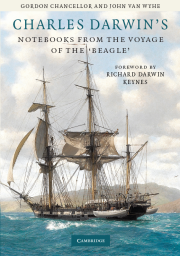
'Always think of home': an introduction to the Buenos Ayres Notebook
The Buenos Ayres Notebook takes its name from the city Buenos Aires ('Good Air' or 'Fair Winds'), on the southern shore of the Río de la Plata, on the coast of Argentina. The notebook was essentially used in three chronological parts. The first part consists of the front thirteen and the back nineteen pages which seem to have been filled in more or less simultaneously; they both have pin holes indicating that Darwin may have pinned them together. This first part covers Darwin's exploration of Buenos Ayres in the first week of November 1832, thus filling a gap in the previous notebook, Rio. In a letter to his second eldest sister Caroline, Darwin wrote 'I much enjoyed this long cruize onshore', Correspondence vol. 1, p. 277, which had been delayed three months by cholera quarantine restrictions.
The second chronological part is in the middle section of the notebook and picks up from the last pages of the Rio Notebook in mid January 1833, with Darwin's first exploration of Tierra del Fuego. See Armstrong 2004. The notebook was then used continuously until around 7 February, when the Falkland Notebook was used instead. There is, however, a third chronological part of the notebook which is in the last couple of pages of this middle section of the notebook. These pages are dated to the last few days of an unspecified month but which is clearly December 1833. These pages relate to Port Desire [Puerto Deseado] in Patagonia, a thousand miles south of Buenos Ayres. The Beagle arrived there on 23 December 1833.
Buenos Ayres, November 1832
The Buenos Ayres descriptions seem to begin just before 1 November 1832 with a mixture of geological observations, zoological memoranda, 'Capinchas dung smells very sweet', p. 16b, and notes on interesting facts Darwin was told, 'it is said that Crocodile occur & small water turtles' p. 2b, some of which would probably turn out to be superstitions, e.g. 'the water has power of turning small bones into large ones', p. 11b. He jotted down various other aides mémoire to himself, 'Museum open every 2nd Sunday', p. 1a; 'Is M. Video built on granite or the Gneiss?', p. 9b. There is a reference to the unusual 'Mendoza waggons' on p. 6a, which Darwin attempted to draw in his Beagle diary, p. 114, and a delightful allusion when riding the next day, five leagues west of the City, to botanizing in the Fens: 'very like Cambridgeshire from Poplars &Willows', p. 6a. Darwin's rather limited draughtsmanship is again exposed in some tiny sketches of tables on p. 15b.
There are long lists of names and addresses, things to buy and have repaired, 'Dentist', 'Watch mended' p. 1a-2a, books to refer to 'Caldcleughs S. America' on p. 2a; this book, Caldcleugh 1825, was in the Beagle's library; 'Spix' on p.10b; (Spix 1824) also in the library with the inscription in volume 2 'Chas. Darwin Octob: 1832 Buenos Ayres'; see Correspondence vol. 1, p. 564, and loans not to be forgotten: 'Mr Hammond owes me 27 paper dollars' p. 3a. It was Lieutenant Robert Hamond (1809-1883) who shared Darwin's interest in the 'Spanish ladies beautiful [dresses] & walk' on p. 5b, an entry which continues with the wonderfully pithy 'went out riding bad roads good horses'. The name Charles Hughes also occurs several times; he was a great help to Darwin in Buenos Ayres and there is a memorandum of information from him in DAR34.14. As the irreplaceable biographical register in the Correspondence indicates, Hughes had attended Shrewsbury School in 1818-9, the year Darwin started at the same school. Darwin was also impressed by Colonel Harcourt Vernon (1801-1880), 'great traveller', p. 7a, probably one of the first European tourists to tackle an overland trek across South America.
Jeff Ollerton has kindly explained to us (personal communication) the rather garbled reference to John Tweedie (1775-1862), a plant collector who had a garden at Retiro. Ollerton has been trying to establish whether Darwin met Tweedie and the fact that he is also mentioned on p. 5a of the St. Fe Notebook tends to support this possibility, which also appears confirmed by a reference in DAR34.13 to information derived from Tweedie.
There are many references to bones, 'Oakleys fossil one scapula in true Tosca', p. 15b; Mr Flint an American Merchant has a tooth', p. 13a, indicating where they might be found or bought, obviously reflecting Darwin's great interest in fossils since his dramatic discoveries at Punta Alta a few weeks previously. Darwin probably met the English merchant Edward Lumb, who played an important role with the fossil mammals, on this excursion, pp. 5a,7b. Oakley 'a joiner with red hair', p. 13b, was the agent of Woodbine Parish (1796-1882), the British consular representative. See Winslow 1975.
There is one entry in another hand, presumably John Meggett's; see p. 10b, and a wistful entry for 1 November on p. 4b: 'Very calm delightful days; [quietness] seems to shorten the distance. always think of home'. This entry became 'A calm delightful day. I know not the reason, why such days always lead the mind to think of England and home' in Darwin's Beagle diary, p. 113.
Tierra del Fuego, January-February 1833
There is a jump in time from the above entries made in Buenos Ayres in November 1832 to the second part of the Buenos Ayres Notebook which was begun in Tierra del Fuego on p.14a on 19 January 1833. Since the last dated entry in the Rio Notebook is 20 December 1832, there is an unrecorded gap of about four weeks, obviously due to the appalling weather, which prevented any land excursions. The field notebooks seem only to have been used at sea for very occasional musings, or lists of equipment and so forth which Darwin jotted, presumably in preparation for going ashore. While on the Beagle, Darwin generally bypassed the notebooks and wrote directly into his Beagle diary, scientific notes or, less regularly, letters.
It is curious that there is no reference in the last pages of the Rio Notebook to Darwin's first encounter with the native Fuegians, which is described in his Beagle diary entry for 18 December, but this could be explained by the fact that some of the Rio Notebook pages have been excised. As he declared in his Beagle diary, 'it was without exception the most curious and interesting spectacle I ever beheld', p. 122, and recorded in his Autobiography how 'the sight of a naked savage in his native land is an event which can never be forgotten', p. 80. Darwin was struck with the realization that his own ancestors lived in a similar way a few thousand years before.
Because of the gap in the notebooks, there is also no mention of the terrible storm of 13 January which wrecked several ships in the seas around the southern tip of South America. This storm nearly brought the Beagle voyage, and the lives of all the men onboard, to a premature end. FitzRoy, in Narrative 2: 126, reported that even in the normally quiet harbour of Berkeley Sound in the Falklands, the whaler Le Magellan was totally wrecked that day. He also says 'Mr Darwin's collections, in the poop and forecastle cabins on deck, were much injured' and the Beagle lost one of its beautiful whale-boats at 1.45pm, when sixty miles WSW of Cape Horn. This latter event was chosen for its drama and historical moment by John Chancellor for his painting Sorely Tried. See Chancellor 2008.

Sorely Tried, HMS Beagle off Cape Horn, 13 January 1833 at 1.45 p.m., by John Chancellor.
The Tierra del Fuego notebook entries start on p. 14a at the eastern end of the Beagle Channel. See Armstrong 2004. There are three pages of geology, then the Fuegians enter the account on p. 17a as FitzRoy begins his excursion in four boats to return the three Fuegians to Jemmy Button's country in Ponsonby Sound, together with the young missionary Richard Matthews (1811-1893). The story of how FitzRoy had taken four living Fuegians, plus one dead one preserved for dissection at the Royal College of Surgeons, to England after the Beagle's first South American commission is of course well known. See the first chapter of Narrative 2. Of the four living Fuegians, FitzRoy's favourite, who he named Boat Memory, sadly died of small-pox in England. The three who survived their sojourn in England and who were returned were the faithful Jemmy Button [Indian name Orundellico], the young girl Fuegia Basket [Indian name Yokcushlu] who had so enjoyed being presented to Queen Adelaide, and the taciturn and by all accounts rather sinister York Minster [Indian name El'leparu].
Darwin filled several pages with detailed geology and some descriptions of the scenery, then on p. 20a noted the natives' 'wild appearance on hill. naked long hair' and on the next page 'innocent naked most miserable very wet'. On p. 22a he indicated that there was some 'fighting with savages'. Then there are more pages of geology before Darwin recorded on p. 29a camping on a starry night surrounded by 'J Button's quiet people' who although naked were perspiring by the large camp fire. Darwin noted that 'after breakfast' many more natives arrived having 'run so fast that their noses were bleeding', p.30a! This dramatic incident eventually appeared in Darwin's published Journal of researches, p. 240.
There is a remarkable entry in Darwin's geological diary dated January-February 1833 which, quite apart from showing how much zoology Darwin mingled with his geology, also demonstrates that barely a year after leaving England he was noticing how animals are not always found in places they appear to have been originally created. In the entry Darwin wrote 'It is very remarkable that J. Button says there are no foxes or Guanacoes in Hoste island, which in every way appears equally well adapted for them [as Navarin Island]. I found however one mouse! (DAR32.101).
Here at Woollya it was decided to build a settlement where Matthews would stay, they hoped on a permanent basis, so the ship's hands cleared the ground and built a hut. Jemmy's three brothers and his mother arrived and Darwin noted, p. 33a, how the natives were surprised by the white mens' skins and their habit of washing themselves. Word spread, and on p. 36a we see that Jemmy's uncle arrived, with friends.
It is remarkable that Darwin scarcely broke the flow of his geological observations to record these extraordinary encounters. He was clearly intrigued by the rather complex field relations of the metamorphic rocks (slates, greenstones etc.) and was particularly concerned to disentangle original bedding from superimposed cleavage, as he had been taught by Henslow and (especially) by Sedgwick in the rather similar rocks of North Wales. See Secord 1991. Anyone who has ever mapped rocks like the clay-slate Darwin was examining knows how difficult it can be to distinguish original bedding from later superimposed cleavage, and it is doubtful if Darwin could have made much sense of the rocks he was seeing if he had not been to Wales with Sedgwick.
'Beds' or 'bedding planes', are the original sedimentary layers, representing the sea bed where the clay accumulated, but they may later be found tipped up (that is 'dipping') or, in extreme cases, upside down. 'Cleavage' adds to the confusion as it results from microscopic re-orientation of certain minerals, such as mica, when subjected to great regional forces, such as the horizontal compression which occurs when continents collide, as was the case in North Wales, where the cleavage planes may be perfect enough to become billiard tables. A clay rock (generally called a shale), once subjected to cleavage becomes a slate. Sedgwick had shown Darwin how, if one can be sure what is bedding and what is cleavage, it is possible to begin to work out the structures which the compression has created, and to work out where the pressure came from. This is why page after page is filled with dips and compass bearings, and Darwin was amazed to discover the immense area over which the cleavage revealed the same orientation.
On p. 38a, 26 January 1833, Darwin mentioned some heteromerous beetles he found and after a curious note, 'Bahia Blanca V[ide] De la Beche?' which may be a reference to De La Beche 1831, he mentioned the 'arrival of women' and the fact that the men seemed to sit watching the women work. On p. 44a the odd events of the night of 27 January were recorded; strangers had arrived and there was 'extreme treachery of character', p. 45a.
The geological observations are interspersed with zoological notes, such as 'Fringilla in flocks' and 'whales blowing', then 'fearless barbarians' arrived, p. 50a. Darwin noted that Jemmy may have forgotten his native language but not his prejudices, as he would not eat land birds, and on p. 54a, Darwin described the beautiful beryl blue of the glaciers. See Herbert 1999. On the same page Darwin mentioned casually his contribution to the saving of one of the ship's boats from being swept away by an iceberg-induced wave. Luckily FitzRoy, in Narrative 2: 217, left an account of this incident, which could have ended in disaster, in which we can see plainly Darwin's natural modesty and at this time his athletic prowess.
The night of the 30/31 January was clearly not much fun and was singled out for a rare dash of ironic humour on p. 59a: 'Miserable sleeping place big stones putrefying sea weed & middle watch. Not all pleasure'. On 1 February near Gordon Island Darwin saw '2 Whale within pistol shot enormous backs and tails', p. 62a.
It is difficult to do justice to the many pages of geology, which are partly the basis for Darwin's statement in South America, p. 151, that his notes on Tierra del were copious. There is reference to various rock formations such as greywacke, granite, gneiss, greenstone, trap, slate, serpentine, schist, hyalomictite, 'amphibolic formation' and so forth, and his extensive mineralogical vocabulary bears witness to his childhood fascination for chemistry and crystallography. There are pages of what today would be called structural geology, following Sedgwick's great interest. Darwin was always trying to make out the big picture: see for example his map of the entrance to Ponsonby Sound on p. 37a. It is perhaps a pity that he never published the geological map of southern South America which is preserved in DAR44 and was published in colour only recently in Herbert 2007, p. 315. This might have made his published descriptions of the whole region rather easier to follow.
Darwin also saw for the first time great boulders which were obviously dropped by glaciers, p. 64a. This first-hand experience of glaciation would be put to good use in 1841 when Darwin, under the influence of Louis Agassiz's glacial theory, re-interpreted the mountains of Snowdonia he had examined with Sedgwick in 1831, without seeing the now obvious signs of recent ice action. See Darwin 1842. The dramatic and inhospitable scenery surrounding the little Beagle left an indelible impression on the young Darwin who, on p. 76a, allowed himself a romantic flourish: 'Is not Tierra del the Ultima Thule' (i.e. a distant place located beyond the 'borders of the known world'.)
Around 6 February an amusing evening was spent bartering for fish, then, p. 74a, Darwin noted Matthews's disappointment at the Fuegians' behaviour. The next evening, p. 77a, Darwin was 'followed by savages' but by firing over their heads he or someone in his party 'frightened them away'. This is the last reference to the Fuegians in this notebook.
On 7 February the Beagle was at Navarin Island and Darwin made a rather obscure entry about a 'trench of diluvium', p. 78a. This entry is an interesting link to his 1842 paper on erratic boulders in which he wrote 'I cannot more accurately describe the appearance of the cliffs around Navarin Island, than by the remark which, at the time, I entered in my note-book, "that a vast debacle appeared to have been suddenly arrested in its course." (Darwin 1842, p. 420; see Herbert 1999, p. 341). The 'note-book' entry Darwin was referring to is actually in his geological diary and is as follows: 'A Debacle sweeping along has been arrested in its course' (DAR32.118). This is the first of two known cases of Darwin mis-quoting his Beagle notes; it consists in the addition of the intensifying adjectives 'vast' and suddenly'. The second mis-quotation is in South America and is in connection with the Pampean Formation and appears to have been a deliberate attempt to bolster his interpretation of that Formation against that of Alcide d'Orbigny. The original statement is from the St Fe Notebook (see introduction to that notebbok) and consists in the substitution of 'tint and compactness' for the more prosaic 'colour and hardness'.
Port Desire, December 1833
The last few dated entries in the Buenos Ayres Notebook relate to Port Desire, and were written just after Christmas 1833. This festival was celebrated by FitzRoy ordering all hands on shore for an 'Olympic Games' involving such curious sports as 'slinging the monkey', as featured in Conrad Martens's watercolour sketched on the spot. See Keynes 1979, p. 173. By this time the Beagle was accompanied by the schooner Adventure which was purchased by FitzRoy in March 1833, at his own expense, and without Admiralty approval.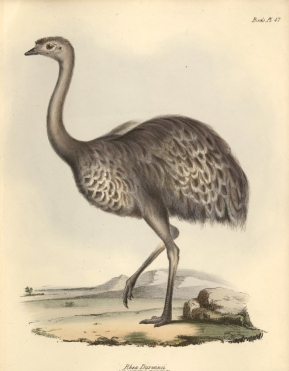
There are some interesting zoological references on these pages, such as 'scorpion eating other scorpion', p. 87a; this is the 'cannibal scorpion' referred to in a footnote of Journal of researches, p. 194. 'Good eye sight of Guanaco', p. 88a, and the date of Christmas Eve given in Zoology notes, p. 186 for the guanaco shot by Darwin at Port Desire and described on pp. 80a-81a is especially valuable. Darwin used his handkerchief as an improvised ruler to measure various parts of the unfortunate creature's anatomy.
Sadly there is no mention either here or in the continuing entries for Port Desire which occur at the start of the Port Desire Notebook of the 'Avestruz Petise' ('small ostrich or rhea') shot by Martens at this time. This bird, closely related to the larger Rhea americana Darwin was familiar with from further north, was skinned and eaten before Darwin suddenly realised it was the smaller type he had heard about. Just in time he remebered reports of a smaller rhea (see introduction to B Blanca Notebook) and rescued the head, neck and legs which were sufficient for John Gould's description in 1837 of what he thought was the new species Rhea darwinii. See Birds, pp. 124-5; actually D'Orbigny had already described it as Rhea pennata in 1834. Herbert 1980, pp. 108-9 provides excellent photographs of both species.
The significance of the Avestruz Petise to Darwin was that it did seem to him to be a different species from the rhea he already knew but with a contiguous geographical range. In other words, one replaced the other going south. This spatial relationship between two closely related bird species struck him as in some way connected to the temporal relationship he had already discovered between the fossil and recent mammals of the same area. Darwin knew that the relationship between the two rheas was a signal of deeper meaning. It was one of the most crucial of the 'certain facts in the distribution of the inhabitants of South America' cited in the first sentence of Origin, p. 1, which led to his theory of evolution.
As so often when on his own, in the last pages of the notebook Darwin waxed lyrical as he reflected, on p. 87a, 'how many hundred years has been. how many will be…sublime view fine colour of rocks'. This reflection was expanded in his Beagle diary to 'All is stillness & desolation. One reflects how many centuries is has thus been & how many more it will thus remain.- Yet in this scence without one bright object, there is high pleasure, which I can neither explain or comprehend.—', p. 209. Finally this became in Journal of researches 'One reflected how many ages the plain had thus lasted, and how many more it was doomed thus to continue.', p. 198.
Gordon Chancellor and John van Wyhe
August 2008
'Buenos Ayres (city) Beagle Channel Ascent of P. Desire Creek.' (11-12.1832-2.1833; 12.1833). Beagle field notebook. Text EH1.12
RN13